If you’re running a small business in Australia right now, you don’t need anyone to tell you that uncertainty is everywhere. Markets shift, customer behaviour changes overnight, regulations keep moving, and it can feel like every time you fix one problem, three new ones appear.
Here’s the reality: you will never have perfect information—and no business owner ever does. The difference between those who succeed and those who struggle isn’t that they avoid uncertainty, but that they know how to make sound decisions in the middle of it.
That’s the focus today: practical steps to steady your decision-making, reduce risk, and give your business the best chance to thrive—even when the ground feels unsteady.

Pause, assess, and widen your view
When uncertainty hits, the most dangerous move is reacting out of panic. Many owners rush to slash costs, pivot their model, or chase new opportunities too quickly, only to regret those choices months later.
Instead, deliberately slow down. Step back and scan what’s really happening. Ask yourself: What exactly is changing? What is just noise, and what is a meaningful signal?
And don’t do this in isolation. Involve your team and trusted advisers. Different perspectives help you spot risks and opportunities you might otherwise miss. One retail client of mine avoided an expensive expansion after their operations manager flagged rising freight costs well before they fully showed up in the financials.
In uncertain times, collaboration is one of your most powerful tools.
Scenario Planning Made Simple
Now, I know “scenario planning” can sound like a corporate jargon. But it’s really just asking, What if?
Think of three scenarios:
- Best case: What if things go better than expected?
- Worst case: What if everything goes wrong?
- Most likely: What’s the realistic middle ground?
Here’s a powerful real‑world example of making decisions under uncertainty.
During the 2008 global financial crisis, Starbucks ran into serious headwinds. Customers were trading down to cheaper options, cutting back on their daily coffee, and sales were falling in key markets. Instead of reacting blindly, Starbucks turned to economic scenario planning. They built four possible futures based on two big unknowns: how deep and long the recession would be, and how confident or pessimistic consumers would feel.
Each scenario led to different priorities—adjusting pricing in some, shifting product mix or loyalty programs in others, or focusing more heavily on innovation and corporate social responsibility. By stress‑testing their choices across all four situations, they were able to sharpen their strategy, allocate resources more intelligently, and stay agile rather than reactive. Starbucks didn’t just survive the recession; it emerged stronger and more resilient.
You might be thinking, “That’s Starbucks—they’ve got global resources. How does that help me?” The principle is exactly the same for small business, just scaled down.
Imagine you run a café.
- Best case: a new development opens nearby and foot traffic doubles.
- Worst case: a road closure slashes walk‑ins by half.
- Most likely: traffic holds steady, but your costs slowly rise.
If you map out what you’d do in each of these situations in advance—pricing changes, roster adjustments, marketing pushes, menu tweaks—you’re not guessing when change hits. You’re executing a plan.
The goal isn’t to predict the future. It’s to build resilience so you can move decisively, whichever version of the future shows up.
Use Strategic Tools
When uncertainty makes decisions feel messy, the right tools can bring structure and clarity.
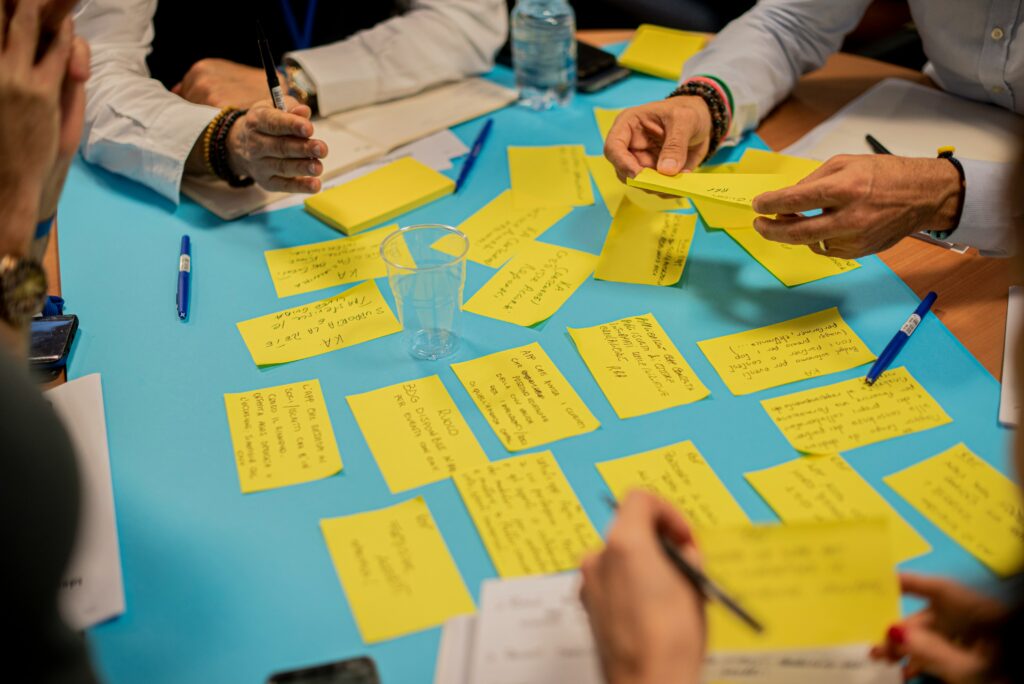
A straightforward example is a decision matrix: list your options, compare them against criteria such as risk, cost, impact, and alignment with your goals, then score each one. What initially feels overwhelming becomes far more organised and easier to weigh up.
Often, you don’t even need anything complex. An honest pros‑and‑cons list can be enough to surface what really matters and point you in a clear direction. Tools won’t decide for you—but they will help you cut through the fog so you can make a more confident call.
Stress-Test Your Assumptions
Smart business owners don’t just ask, What could go right? They ask, What could go wrong?
Challenge your assumptions. If you’re banking on a supplier keeping prices stable, stress-test it—what if they raise prices by 10%? If you’re assuming customers will stay loyal, ask—what if a competitor undercuts me?
Risk assessments don’t have to be complex. Even a quick checklist of “what ifs” can save you from costly surprises.
Rational vs. Irrational Fears
Uncertainty doesn’t just affect your numbers—it affects your thinking.
That’s why it helps to distinguish between rational risks and irrational fears. Rational risks are things you can quantify, like rising input costs, delayed deliveries, or a key client leaving. Irrational fears are the emotional spirals—the “What if everything falls apart tomorrow?” stories your mind runs in the background.
The aim is to stay proactive rather than reactive. Focus on what you can influence, take clear, practical steps on those areas, and consciously release the rest. It’s not always easy, but even naming the difference between real risks and imagined disaster can lighten the emotional load and lead to better decisions.
Move with Intent
Once you’ve assessed, planned, and stress‑tested your options, the key is not to stay stuck—move with intent.
Set clear priorities, communicate openly with your team, and give yourself a little space to reflect before making the big calls. Uncertainty doesn’t mean standing still; it means moving forward deliberately, confident that you’ve thought things through.
Final Thoughts
Here’s the core message: you will never eliminate uncertainty—but you can learn to manage it and make better decisions in the middle of it.
Pause before reacting. Use simple scenario planning. Lean on tools like decision matrices. Stress‑test your assumptions. Keep your emotions in check. Then move forward deliberately, rather than by default.
At Excelerated Business Solutions, I work with Australian SMEs to make confident decisions in unpredictable conditions, and to build strategies that hold up even when the market doesn’t. If you’d like support doing that in your own business, reach out—let’s steady the ship and move it forward together.

Because uncertainty is inevitable. Smart choices reduce risk, build resilience, and keep your business adaptable.
Pause, assess, and gather perspectives before rushing into decisions.
It prepares you for best, worst, and most likely outcomes—soyou’re not caught off guard.
Decision matrices, pros and cons lists, and risk assessments are simple yet effective.
Focus on rational risks you can measure, and challenge emotional assumptions with facts.
Resources
https://fastercapital.com/content/Economic-Scenario-Planning–Marketing-Strategies-for-Thriving-in-Changing-Economic-Landscapes.html